The June 1977 issue of
After Dark featured Norma Kamali. Ms. Kamali was featured in an article called “Face to Face with Make-up Artist Pierre Laroche”. The interesting thing to me was the length of the captions. The captions were longer than some features in most issues.

Nine years ago, after working in dress shops in London and Paris, Norma Kamali grew tired of selling other people’s fashions and decided to create her own. Establishing outlets in New York City and Beverly Hills, she has become one of the most popular dress designers for a select group of film stars, socialites, and fashion-conscious women who find her clothes to be the ultimate in haute couture. Kamali makes no sketches. She begins with a general idea, selects an unusual fabric, and lets the material dictate where that idea will go. The result? Shirred swimsuits, gypsy skirts, voile romp suits, tablecloth dresses, and jumpsuits made of antique parachute silk, like the one worn by Pierre Laroche in this feature. Though she allows her customers to wear her fashions in their own way, Kamali prefers to be known as a designer who channels a basic garment into an unexpected area by adorning it with contrasting accoutrements. A look at Kamali’s one-of-a-kind shop at 787 Madison Avenue reveals that this is obviously the thrust of her work, as does Kamali herself, who wears her own fashions the way she likes them while matiently attending to her demanding clientele. Although her work has been featured in every major magazine in the United States and although her name has become familiar among those who have developed a passion for her clothes, Kamali refuses to reap false glory by having her name linked with the famous women for whom she has designed. Her description of the style she is stressing this summer serves as an incisive self-portrait: “comfortable, beautiful, very feminine.”

“I’m not at all related to Lauren, “ retorts Linda Hutton, correcting the general assumption that she’s Lauren Hutton’s younger sister. Interested in making animated movies for children, Linda majored in film at the University of Southern California and then returned home to New York to find work—as a model for
Harper’s Bazaar and
Mademoiselle (“It takes money to make movies”). How long does she intend to remain in the world of fashion? “Until I start tearing my hair out,” she replies. “You know, I’m older than most of those girls. The crow’s feet are beginning to set in, but I guess I can pass as younger for a few more years. Then I’m going to move to the country—and get a lot of dogs.” Between modeling assignments, Linda appeared as a student in the movie
The Man Who Fell to Earth, starring David Bowie. Now that she’s been a fashion model for two years, what does she think of Pierre Laroche’s make-up? “He’s fabulous.”

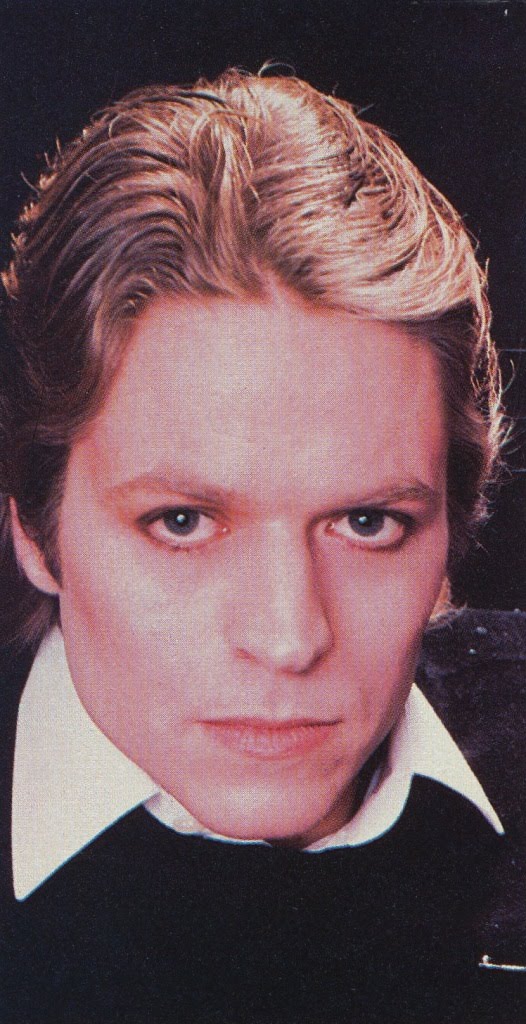
British Robert Palmer, one of the most exciting white soul singers to emerge in the seventies, began his musical career at the age of nineteen with a band of fellow art students called the Mandrakes. Two years later he was spotted by Alan Bown, leader of one of Britain’s first horn bands, who asked him to join the group as a vocalist. Palmer stayed for a year and a half until guitarist Pete Gage persuaded him to help initiate a new jazz-rock ensemble called Dada, which was pared down to the popular band Vinegar Joe. Eventually tiring of the group because it left him no room to develop his interest in rhythm and blues, Palmer quit in 1974, put together tapes of his own songs, and took them to Chris Blackwell of Island Records. Liking what he heard, Blackwell teamed Palmer with producer Steve Smith and sent them to the United States to make a solo album. Hailed by critics, “Sneakin’ Sally Through the Alley”, Palmer’s first LP, established him as a respected cult figure until he released his noticeably changed second album “Pressure Drop”, which poised him on the brink of mass popularity. As different as the first album is from the second, “Some People Can Do What They Like”, Palmer’s third album, is even more stylized than “Pressure Drop”, since he was able to spend more time arranging the vocals and extending some of his studio techniques. Touted as “the hottest act since Patti Smith,” Palmer has played numerous sold-out concerts, exhibiting a smoothie English sex appeal that has caused even men to scream out, “Unbutton your shirt, please, Robert Palmer.”

Elsa Peretti burst onto the New York scene in 1968, when fashion designers Giorgio di Sant’Angelo and Halston displayed her first two pieces of jewelry: a tiny bud vase on a chain and a heart-shaped belt. Not intending to become a career woman after growing up in a wealthy Italian family, Peretti quickly changed her mind when the public went mad for her designs. Wanting to create with precious stones, she was introduced to Tiffany chairman Walter Hoving and president Harry Platt, who hired her immediately. Soon after, Peretti’s new collection of jewelry was featured as a real-life
Breakfast at Tiffany’s, attended by thousands of customers who in one year ordered two miles of “diamonds by the yard,” 10,000 teardrops, 10,000 bean pendants, and hundreds of $200 belt buckles. Tall, elegant, not to be tampered with, Peretti is an insatiable perfectionist in her work and a volatile personality in her private life. With equal force she can shape a lump of model wax with razor-sharp accuracy or throw her $35,000 sable coat into Halston’s fireplace, leaving him to watch it burn.

Born in Hong Kong, Amanda Lear rejected her middle-class upbringing in France and moved to London, where she became a model. Through mutual friends, she met David Bowie and the two recorded the single “Trouble”, which became a hit in Germany. Based on the record’s success, Lear subsequently released the disco-oriented “Blood and Honey”, which typed her as “the white Donna Summer.” Now preparing her first LP, she describes herself as an entertainer rather than a liberated female singer with a message for the world. Infatuated with the instant recognition the pop media provides, with its appeal to the masses, Lear claims, “If Hitler were to come back, I’m sure he’d be a rock star.” Rumored to be a transsexual, Lear adores the sensational publicity the false accusation has brought her on her way to proving she is more than a mannequin. Entranced with public attention, she also “likes big boys with little brains” and asserts in the words of Oscar Wilde that “ambition is a result of failure”—in her case, failure to love anyone for more than fifteen minutes. A longtime companion of Salvador Dali, she denies reports that she is his lover. The famed surrealist artist became her faithful friend ten years ago at a Parisian discotheque after the following prophetic meeting. Dali: “You have a face like a death skull.” Lear: “That’s a compliment?” Dali: “You don’t understand. I love bones.”

Following a lonely childhood in exotic Algiers, Pierre Laroche moved to France and then England, where he became the star make-up artist at Elizabeth Arden in London. Quitting after five years when the company insisted he become more conservative, Laroche went freelance and was soon contracted by rock stars David Bowie and Mick Jagger, who drew upon Laroche’s talent while he continued to do make-up for British fashion magazines, celebrities, and movie stars. During the sixties, inspired by the Arab women of his homeland who painted their eyes black with khool, Laroche popularized black eye-shadow and originated the glitter look. Later, he moved to America, where he reorganized his professional approach to include make-up for all kinds of women—and men. Though he recently did Bianca Jagger’s make-up for the cover of
People magazine, Elsa Peretti’s make-up for Helmut Newton’s photograph of her in the April 4 issues of
Newsweek, and has worked with Nona Hendryx on major make-up projects, Laroche is equally interested in designing make-up for the “average woman”. Intent on contributing to the American chic, Laroche asserts, “I have lived through the sixties in England. Now I’m getting ready to face the eighties in America.”

The Summer Bookfest ’77 featured reviews of some of the must-reads which included
Monty by Robert LaGuardia. Luckily, the review featured many photographs of the subject of the book—Montgomery Clift. This first photo is a candid shot of Clift from the early 50’s.
Montgomery Clift and Elizabeth Taylor relax on location at Lake Tahoe during the filming of
A Place in the Sun.

In 1940, the young and gorgeous Montgomery Clift on stage with Lynn Fontanne and Alfred Lunt in
There Shall Be No Night.
 You Touched Me!
featured Marianne Stewart, Catherine Willard, and Neal Fitzgerald with Montgomery Clift.

At age 18, Clift appeared with his friend Morgan James and Forrest Orr in
Dame Nature.
 Indiscretions of an American Wife
starred Monty with Jennifer Jones.

Maureen Stapleton with Monty from the film
Miss Lonely Hearts.

During the shooting of
Raintree County, with Eva Marie Saint, Monty’s face was severely damaged in a car accident.

He appeared in
From Here to Eternity with Donna Reed who received an Academy Award for her performance.

One of my favorite movies,
Suddenly, Last Summer featured Katharine Hepburn and Elizabeth Taylor with Clift and some wonderful Tennessee Williams’ dialogue.

Shelley Winters co=starred in A Place in the Sun with Clift.

I’ll list the other books in the Part 2 post of this issue, but before I finish with Part 1, there is one more thing I wanted to share. Photographer Victor Arimondi had some of his art photographs featured in this issue. According to the feature by William Como, Arimondi considers people as raw materials with whom he fashions a shadowy world of compelling character fantasies rather than producing conventional portraiture.